Dialogue
Mot or parole? Practise words, speaking turns and promises
Join a French conversation about a song. Practise asking about a word, taking the floor, understanding paroles and giving your word.
- A2
- 12 lines
- Practice mode
- Learn this in the A2 notebook →
In short
Un mot is a word you can learn, spell or count. La parole concerns speaking; les paroles can mean remarks or song lyrics. Watch the small word: donner la parole gives someone a speaking turn; donner sa parole gives a promise.
Yellow the idea to rememberBlue French to learnRed watch out
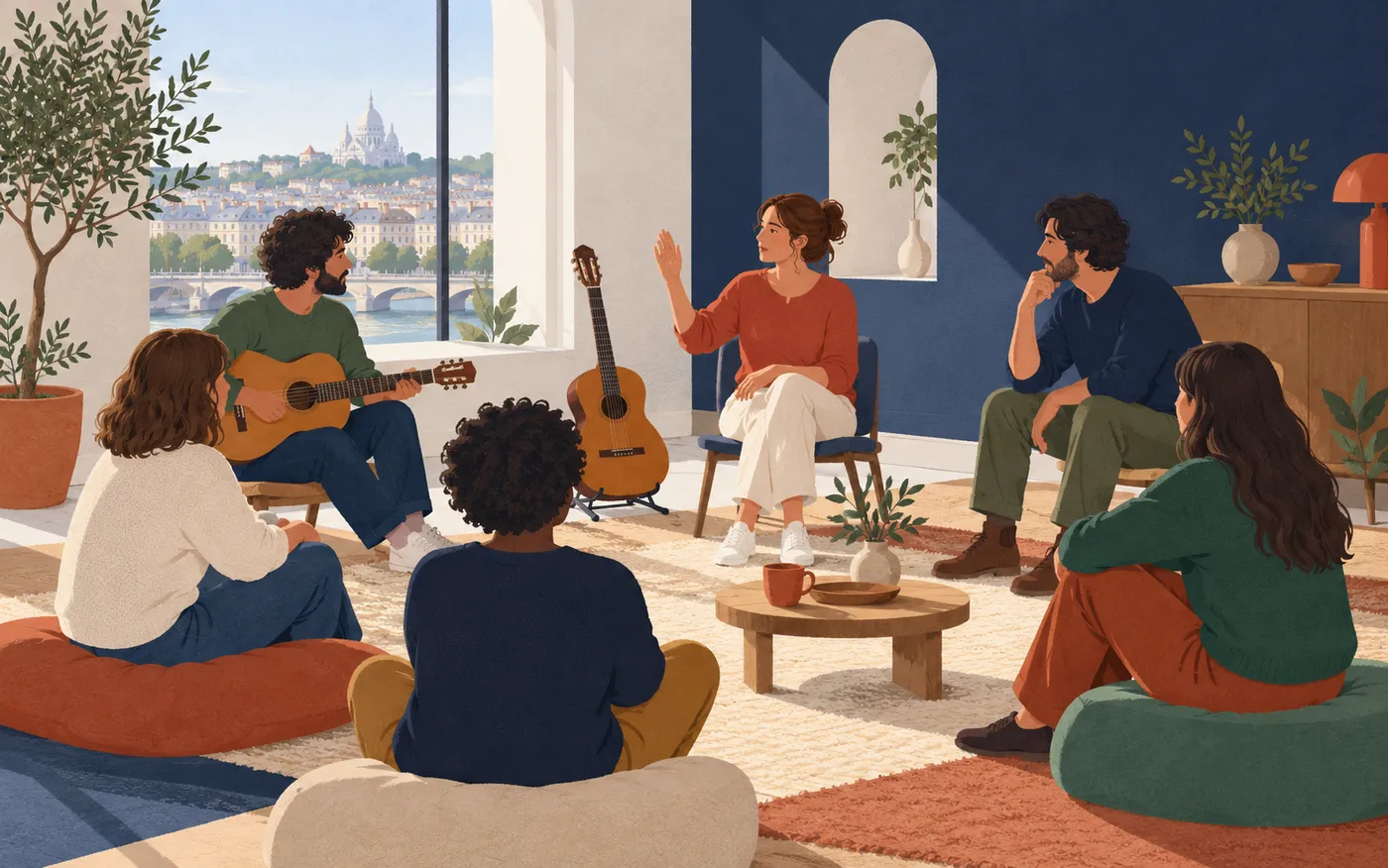
What is the difference between mot and parole?
- Animatrice
Aujourd’hui, nous parlons d’une chanson. Qui veut commencer ?
English
Today we’re talking about a song. Who wants to start?
- Camille
Je peux prendre la parole ?
Ask whether you can take the floor.
English
Can I take the floor?
- Animatrice
Bien sûr, tu as la parole.
English
Of course, you have the floor.
- Camille
Il y a un mot que je ne comprends pas dans la chanson.
Say you do not understand one word in the song.
English
There’s one word in the song I don’t understand.
- Animatrice
Quel mot ?
English
Which word?
- Camille
Que veut dire « retrouvailles » ?
Ask what retrouvailles means.
English
What does “retrouvailles” mean?
- Animatrice
Ce sont des moments où l’on se revoit après une séparation.
English
It means occasions when people meet again after being apart.
- Camille
Merci, je comprends mieux les paroles maintenant.
Say you now understand the lyrics better.
English
Thanks, I understand the lyrics better now.
- Animatrice
Tu peux nous présenter une autre chanson la semaine prochaine ?
English
Can you introduce another song to us next week?
- Camille
Oui, je te donne ma parole : je prépare quelque chose.
Promise to prepare something.
English
Yes, I give you my word: I’ll prepare something.
- Animatrice
Parfait. Je te laisse un petit mot avec la date.
English
Perfect. I’ll leave you a short note with the date.
- Camille
Merci. Et je tiendrai parole !
Say you will keep your word.
English
Thanks. And I’ll keep my word!
| Expression | Meaning | Another example |
|---|---|---|
| un mot | a vocabulary word | Comment écrit-on ce mot ? |
| un petit mot | a short written note | Je te laisse un petit mot. |
| les paroles | lyrics or spoken remarks | Ses paroles me rassurent. |
| prendre la parole | take the floor | Nora prend la parole après moi. |
| couper la parole à quelqu’un | interrupt someone | Ne me coupe pas la parole. |
| tenir parole | keep your word | Elle a tenu parole. |
Mot is masculine; parole is feminine. A short note can contain many mots. The expression les paroles de la chanson names the lyrics as a whole, while un mot dans la chanson singles out one vocabulary item.
A speaking turn or a promise?
Je donne la parole à Nora.
I give Nora the floor.
Je donne ma parole à Nora.
I give Nora my word.
The article la marks a speaking turn. The possessive ma marks the speaker’s promise. In tenir parole, leave out the article. En quelques mots means “in a few words”: résume la chanson en quelques mots.