Dialogue
Texte or discours: prepare a French speech with a partner
Follow a conversation about a speech script, practise the speaker’s lines and learn texte, discours, prononcer un discours and discours indirect.
- B1
- 12 lines
- Practice mode
- Learn this in the B1 notebook →
In short
Un texte is a text or the wording of a piece. Un discours can be a speech to an audience, or a way of presenting ideas. Le texte du discours is the speech’s text or script: the two words fit together naturally.
Yellow the idea to rememberBlue French to learn
| French | English | Focus |
|---|---|---|
| préparer un discours | to prepare a speech | the whole speech |
| relire le texte | to reread the text | the wording |
| prononcer un discours | to deliver a speech | speaking to an audience |
| le texte intégral | the full text | the complete wording |
| un extrait du discours | an extract from the speech | only part of it |
- Camille
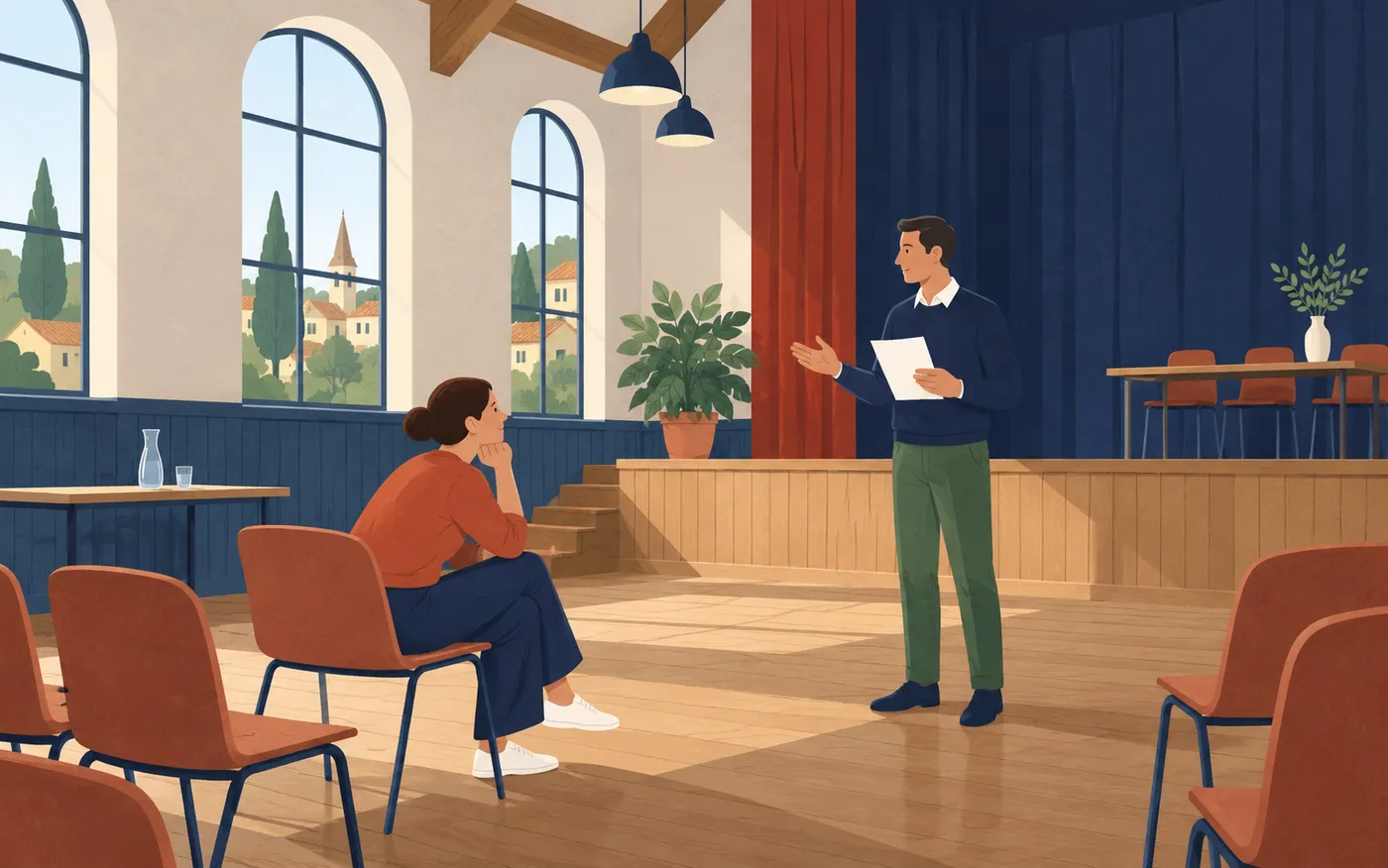
Tu as préparé ton discours pour l’ouverture de l’atelier ?
English
Have you prepared your speech for the workshop opening?
- You
Oui. Tu peux relire le texte avec moi ?
Say yes and ask Camille to reread the text.
English
Yes. Can you reread the text with me?
- Camille
Bien sûr. Tu commences comment ?
English
Of course. How do you start?
- You
Bienvenue à tous dans notre atelier de lecture.
Give a short welcome to the reading workshop.
English
Welcome, everyone, to our reading workshop.
- Camille
C’est clair. Et ensuite ?
English
That’s clear. And next?
- You
Je remercie les bénévoles, puis j’explique notre projet.
Say that you thank the volunteers and explain the project.
English
I thank the volunteers, then I explain our project.
- Camille
Lis maintenant tout le texte à voix haute.
English
Now read the whole text aloud.
- You
D’accord. Je vais lire lentement pour vérifier le rythme.
Agree and say you will read slowly to check the rhythm.
English
All right. I’ll read slowly to check the rhythm.
- Camille
Tu vas prononcer ton discours sans regarder tes notes ?
English
Are you going to deliver your speech without looking at your notes?
- You
Je vais garder le texte devant moi, mais je regarderai le public.
Say you will keep the text in front of you, but look at the audience.
English
I’ll keep the text in front of me, but I’ll look at the audience.
- Camille
Et pour finir ?
English
And to finish?
- You
Je vous invite à présenter un livre que vous aimez.
Invite everyone to share a book they like.
English
I invite you to introduce a book you like.
What is the difference between texte and discours?
Le discours publicitaire insiste sur la nouveauté.
Advertising discourse emphasises newness.
Here discours names a way of presenting ideas across messages. It can describe repeated arguments, vocabulary or framing. It need not refer to one person giving a speech.
Elle dit : « Je prépare un discours. »
She says: “I’m preparing a speech.”
Elle dit qu’elle prépare un discours.
She says that she is preparing a speech.
These are le discours direct and le discours indirect: the grammatical terms for direct and reported speech. Both texte and discours are masculine. In the plural, write des textes and des discours.