Conjugation table
Sortir conjugation: sors, sortons, sorti and the two auxiliaries
Conjugate sortir in seven key tenses and moods. Compare je suis sorti with j’ai sorti les poubelles, then practise present forms, agreement and auxiliaries.
- A1
- 8 tenses
- Auxiliary: être / avoir
- Learn this in the A1 notebook →
In short
Sortir means “to go out” or “to take out”: je sors, nous sortons. In the compound past, use être for going out (elle est sortie) and avoir when you take something out (elle a sorti les clés). The past participle is sorti.
Yellow the idea to rememberBlue French to learn
Study first: the forms and one example per tense
- Infinitive
- sortir
- Past participle
- sorti
- Present participle
- sortant
- Auxiliary
- être / avoir
Présentnow and repeated actions
| je | sors |
| tu | sors |
| il / elle / on | sort |
| nous | sortons |
| vous | sortez |
| ils / elles | sortent |
Nous sortons après le cours.
We go out after the lesson.
Passé composé · êtregoing out: agreement with the subject
| je | suis sorti(e) |
| tu | es sorti(e) |
| il / elle / on | est sorti(e) |
| nous | sommes sorti(e)s |
| vous | êtes sorti(e)(s) |
| ils / elles | sont sorti(e)s |
Léa est sortie à huit heures.
Léa went out at eight.
Passé composé · avoirtaking something or someone out
| j’ | ai sorti |
| tu | as sorti |
| il / elle / on | a sorti |
| nous | avons sorti |
| vous | avez sorti |
| ils / elles | ont sorti |
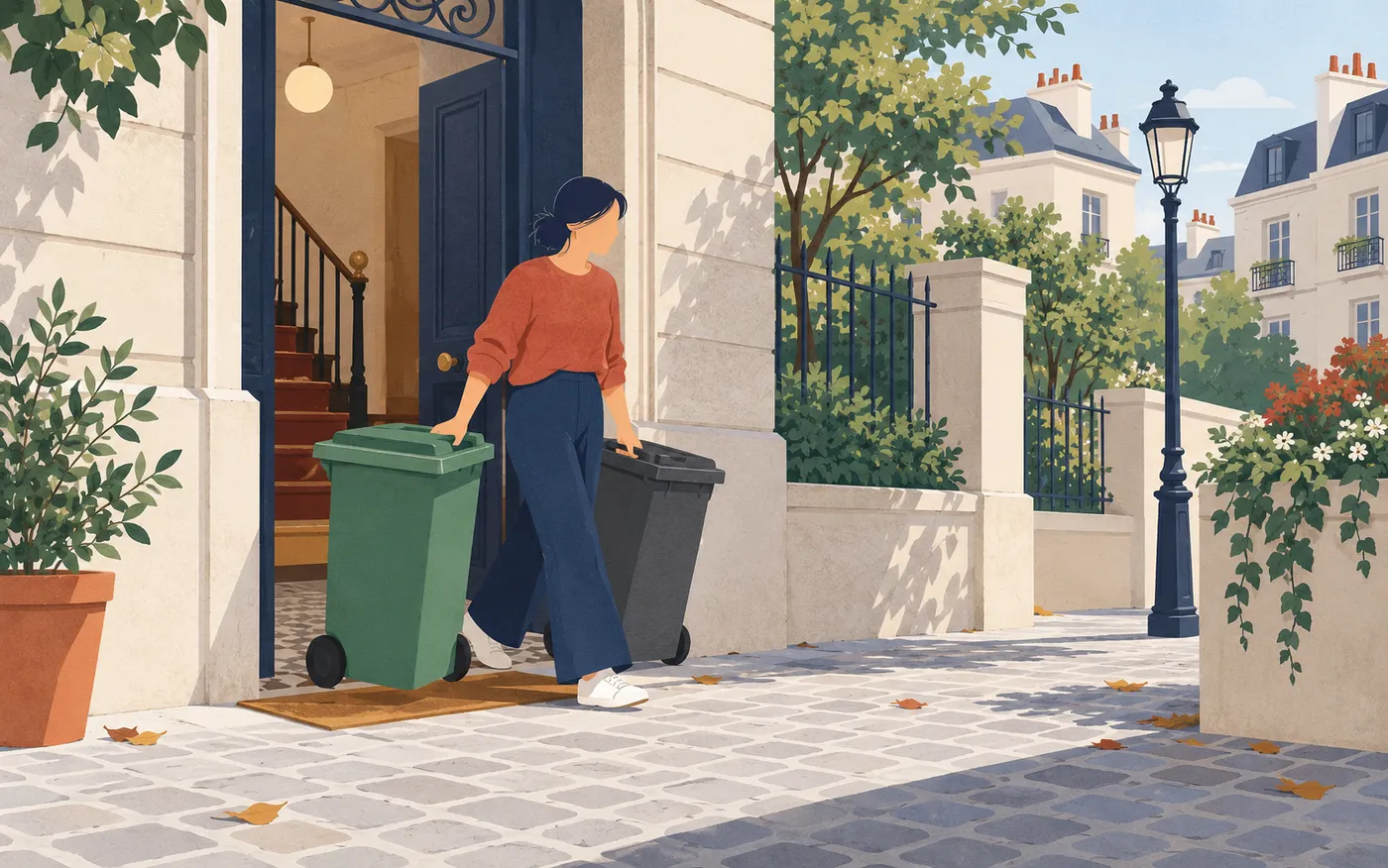
J’ai sorti les poubelles.
I took the bins out.
Imparfaitpast habits and background
| je | sortais |
| tu | sortais |
| il / elle / on | sortait |
| nous | sortions |
| vous | sortiez |
| ils / elles | sortaient |
Avant, je sortais chaque samedi.
I used to go out every Saturday.
Futur simplea future action
| je | sortirai |
| tu | sortiras |
| il / elle / on | sortira |
| nous | sortirons |
| vous | sortirez |
| ils / elles | sortiront |
Tu sortiras après le déjeuner.
You will go out after lunch.
Conditionnel présentan imagined action or a suggestion
| je | sortirais |
| tu | sortirais |
| il / elle / on | sortirait |
| nous | sortirions |
| vous | sortiriez |
| ils / elles | sortiraient |
À ta place, je sortirais plus tôt.
If I were you, I would go out earlier.
Subjonctif présentafter a trigger such as il faut que
| que je | sorte |
| que tu | sortes |
| qu’il / qu’elle / qu’on | sorte |
| que nous | sortions |
| que vous | sortiez |
| qu’ils / qu’elles | sortent |
Il faut que nous sortions maintenant.
We need to go out now.
Impératifinstructions and invitations
| (tu) | sors |
| (nous) | sortons |
| (vous) | sortez |
Sortez par cette porte, s’il vous plaît.
Please leave through this door.
Who goes out, and what gets taken out?
For going out, sorti agrees with the subject: il est sorti, elle est sortie, ils sont sortis, elles sont sorties. With vous, write vous êtes sorti for one man, sortie for one woman, sortis for a male or mixed group, and sorties for an all-female group. In elle a sorti les clés, the object follows the verb, so sorti stays unchanged.
sortir de quelque partto come out of a place
Focus: the person moves
Nous sommes sortis du cinéma.
We came out of the cinema.
sortir quelque choseto take something out
Focus: the person moves an object
Nous avons sorti les chaises.
We took the chairs out.
The present je and tu forms lose the -t- of the stem: je sors, tu sors. It returns in nous sortons, vous sortez and ils sortent. Start with the present and the two compound-past patterns; the later-tense tables are here as a reference for future lessons.
- Je sort tous les soirs.Je sors tous les soirs.
The je form ends in -s; il sort ends in -t.
- Léa a sorti à huit heures.Léa est sortie à huit heures.
Léa goes out herself, so use être and feminine sortie.
- Léa a sortie les clés.Léa a sorti les clés.
With avoir, the participle does not agree with the subject. Here the object follows, so write sorti.
- Nous sommes sorti les chaises.Nous avons sorti les chaises.
Taking an object out uses avoir: avons sorti.
1 · Recall the six present forms
- je
- tu
- il / elle / on
- nous
- vous
- ils / elles
2 · Change the tense: follow the hint
- Hier soir, Léa avec ses amis. (sortir · passé composé; Léa goes out)
- Nous souvent ensemble à cette époque. (sortir · imparfait)
- Demain, je à midi. (sortir · futur simple)
- Il faut que tu maintenant. (sortir · subjonctif présent)