Buying at a French market stall: the queue, the weights and what to say
How a French market stall works: who serves and who helps themselves, how to ask for a weight, a number or a slice, whether to bargain, how to pay, and when to go.
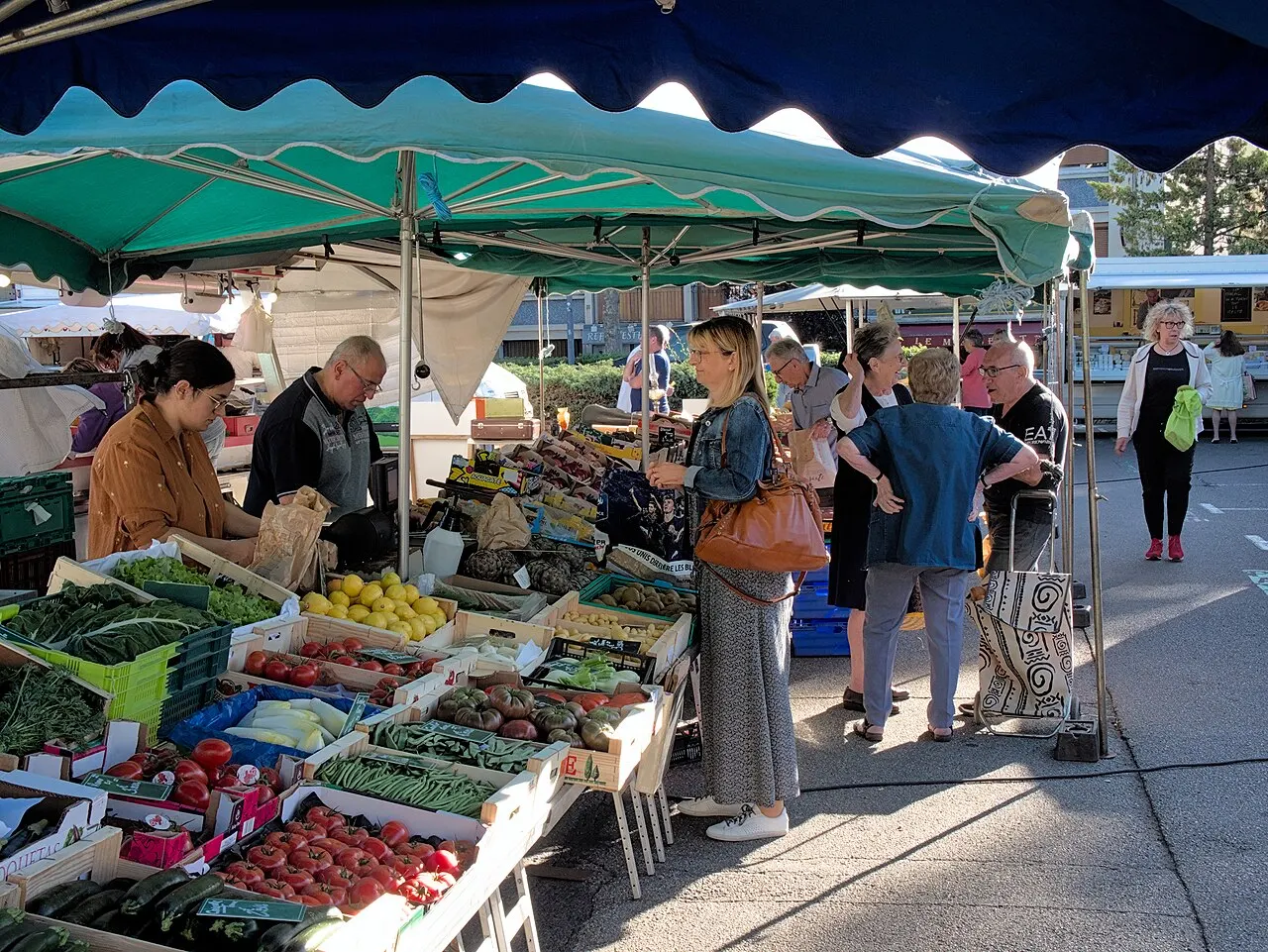
Wait your turn, say bonjour, and ask for a weight or a number: un kilo, une livre, six. At most stalls the seller picks the produce: do not touch unless you see bags or bowls put out for customers. Nobody bargains over a kilo of tomatoes.
Yellow the idea to rememberBlue French to learnRed watch out
Whose turn is it
There is rarely a line. People stand along the stall and each knows who was there before them. The seller asks À qui le tour ? and the next person says C’est à moi. If you are not sure, ask the person beside you: Vous étiez avant moi ? Jumping the order is the one real rudeness of a market.
- À qui le tour ?Who’s next?
- C’est à moi. Bonjour ! Une livre de cerises, s’il vous plaît.Me. Hello! Half a kilo of cherries, please.
- Voilà. Et avec ceci ?There. Anything else?
- Quatre tomates, pas trop mûres.Four tomatoes, not too ripe.
- Ce sera tout ?Will that be all?
- Ce sera tout, merci.That’s all, thanks.
Served, or self-service
How to tell
- The seller servesservice
Produce is stacked in pyramids facing you and the seller stands behind. Point and ask.
do not touch - You help yourselflibre-service
Plastic bowls, paper bags or baskets are hanging at the front. Fill one and hand it over to be weighed.
help yourself - Either wayles fruits fragiles
Never squeeze peaches, figs or apricots. Say when you will eat them and let the seller choose.
ask
Asking for an amount
Weights, numbers and pieces
- un kilo de… a kilo of1 000 g
About 2.2 pounds. Six large tomatoes, eight apples.
- une livre de… a pound of500 g
Half a kilo. The old word is alive at every market.
- une demi-livre de… half a pound of250 g
For mushrooms, cherries, olives.
- deux cents grammes de… 200 grams of200 g
For cheese, olives, charcuterie.
- six, une douzaine six, a dozenby number
Eggs, oysters, apricots.
- une tranche, un morceau a slice, a pieceby the piece
Ham, pâté, cheese. Show the size with your fingers.
- une poignée, une botte, une barquette a handful, a bunch, a punnetas sold
Parsley, radishes, strawberries.
Un peu plus. Un peu moins. C’est parfait. A little more, a little less, that is perfect.
poids500 g
prix au kilo4,8 €
à payer2,40 €
The price on the slate is per kilo unless it says la pièce or la botte. The scale shows the weight and the price to you as well as to the seller.
Prices, bargaining and paying
- No bargaining
Prices are fixed and displayed. Haggling over food is not done. At a flea market, une brocante, it is expected.
- The last half hour
From about half past twelve, sellers shout reductions to clear the stall: Allez, deux barquettes pour le prix d’une ! That is the moment for jam fruit and soup vegetables.
- Cash or card
Most stalls now take cards, often from one euro. Small growers may not: carry coins and small notes. A fifty-euro note for two euros of parsley is unwelcome.
- Bags
Bring your own basket or bag. Thin plastic bags are banned; you will be given paper.
- A little extra
A regular customer gets a handful of parsley or a lemon thrown in: Je vous mets un peu de persil ? Say yes.
When to go
- 7–8 am still setting up
- 8–10 am best choice, no crowd
- 10–noon busy; queues at the good stalls
- noon–1 pm bargains, little left
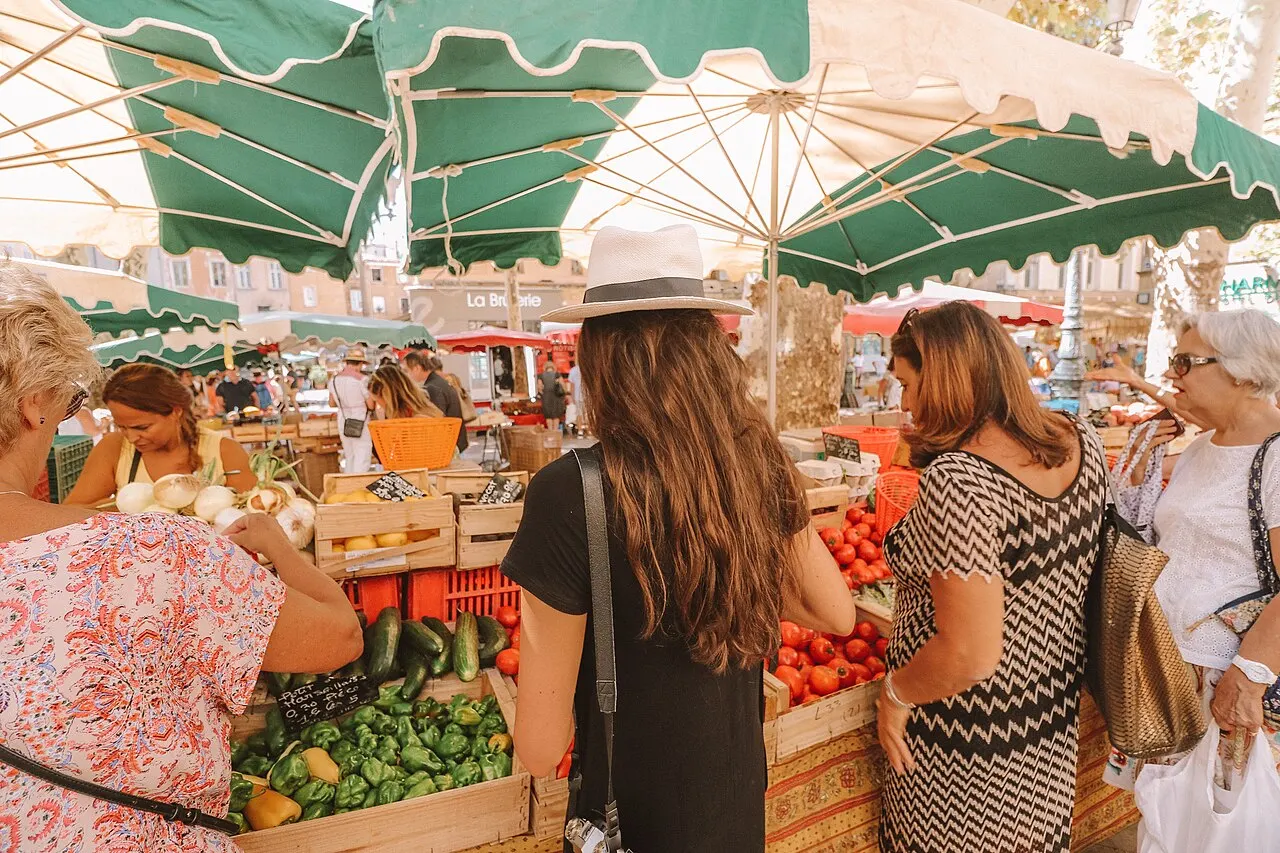
Markets are a morning affair: stalls are packed away by one or half past. A few cities have afternoon or evening markets, and covered markets, les halles, open all day and close on Mondays. Your town hall’s website lists the days: search for jours de marché and the name of the town.
The stalls, by name
| French | English |
|---|---|
| le primeur, le maraîcher | the greengrocer; the market gardener who grows his own |
| le fromager, le crémier | the cheesemonger |
| le boucher, le charcutier | the butcher; the pork butcher |
| le volailler | the poultry seller, often with roast chickens |
| le poissonnier | the fishmonger |
| le boulanger | the baker |
| le traiteur | ready-cooked dishes to take away |
| le fleuriste | the florist |
- Asking to taste
« Elles sont très bonnes, les fraises. »
The strawberries are very good.
« Je peux goûter ? »
May I taste one?
- Asking the origin
« Vous cherchez quelque chose ? »
Looking for something?
« Elles viennent d’où, vos tomates ? »
Where are your tomatoes from?
- Asking how to cook it
« C’est du céleri-rave. »
That is celeriac.
« Ça se prépare comment ? »
How do you cook it?
- Paying
« Ça fait sept euros quarante. »
That’s 7.40.
« Par carte, c’est possible ? »
Can I pay by card?
Ça se prépare comment ? is the best question on any market. Stallholders love it, and the person behind you in the queue will usually add a recipe.