French road signs that confuse foreign drivers, and what each means
The yellow diamond, the town-name sign that sets a speed limit, rappel, sauf riverains, the unmarked junction: the French road signs and rules that catch visiting drivers, each with what to do.
Three things catch visitors: a junction with no sign means give way to the right; the town’s name on a white sign means 50 km/h; and a yellow diamond means you have priority until it is crossed out. Words under signs matter too: rappel is a reminder that a limit still applies, not a new one.
Yellow the idea to rememberBlue French to learnRed watch out
Priority: the four cases
At a junction
- stop
Wheels must stop completely, even on an empty road. A rolling stop is fined.
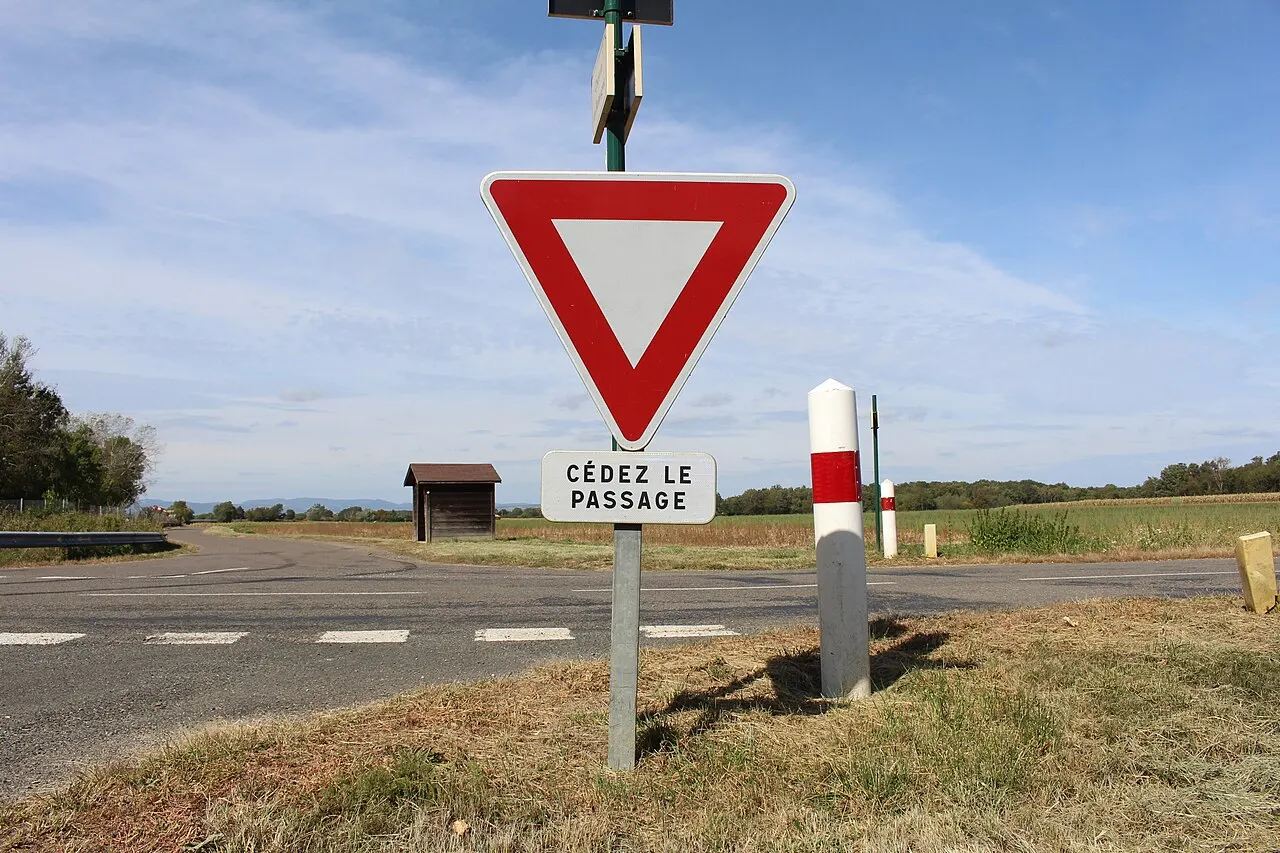
- cédez le passage
Give way; no need to stop if nothing is coming.
- route prioritaire
You have priority at every junction until the same sign appears with a black bar across it.
- aucun panneau
No sign at all: whoever comes from your right goes first (priorité à droite). Common in towns and villages.
No signs at all: priorité à droite
- The car on your right Nobody is on its right.
- You You give way to your right, then go.
- The car on your left You are on its right, so it waits for you.
You are the red car, coming from the bottom. A side street on your right has priority over you even if your road looks bigger.
Speed limits you are not shown
Signs that set a limit without a number
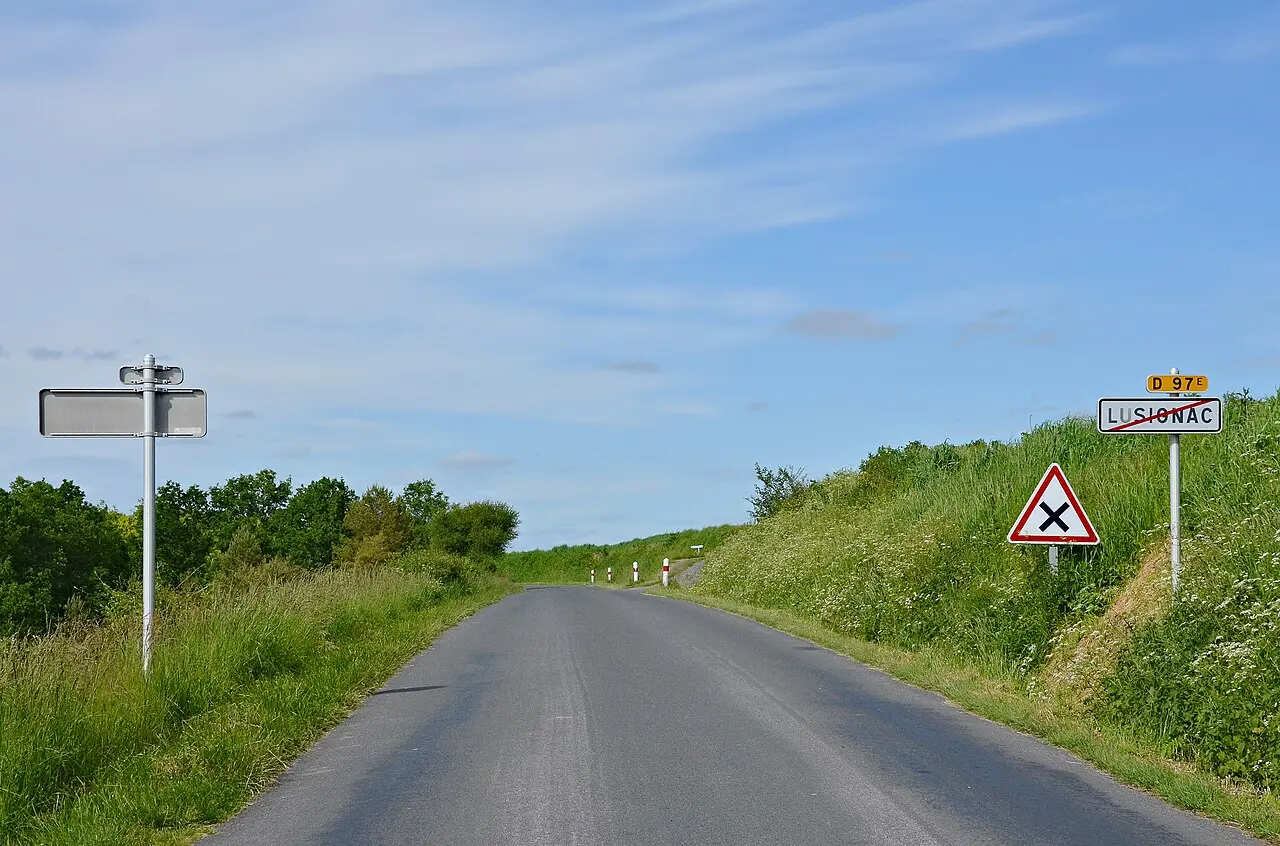
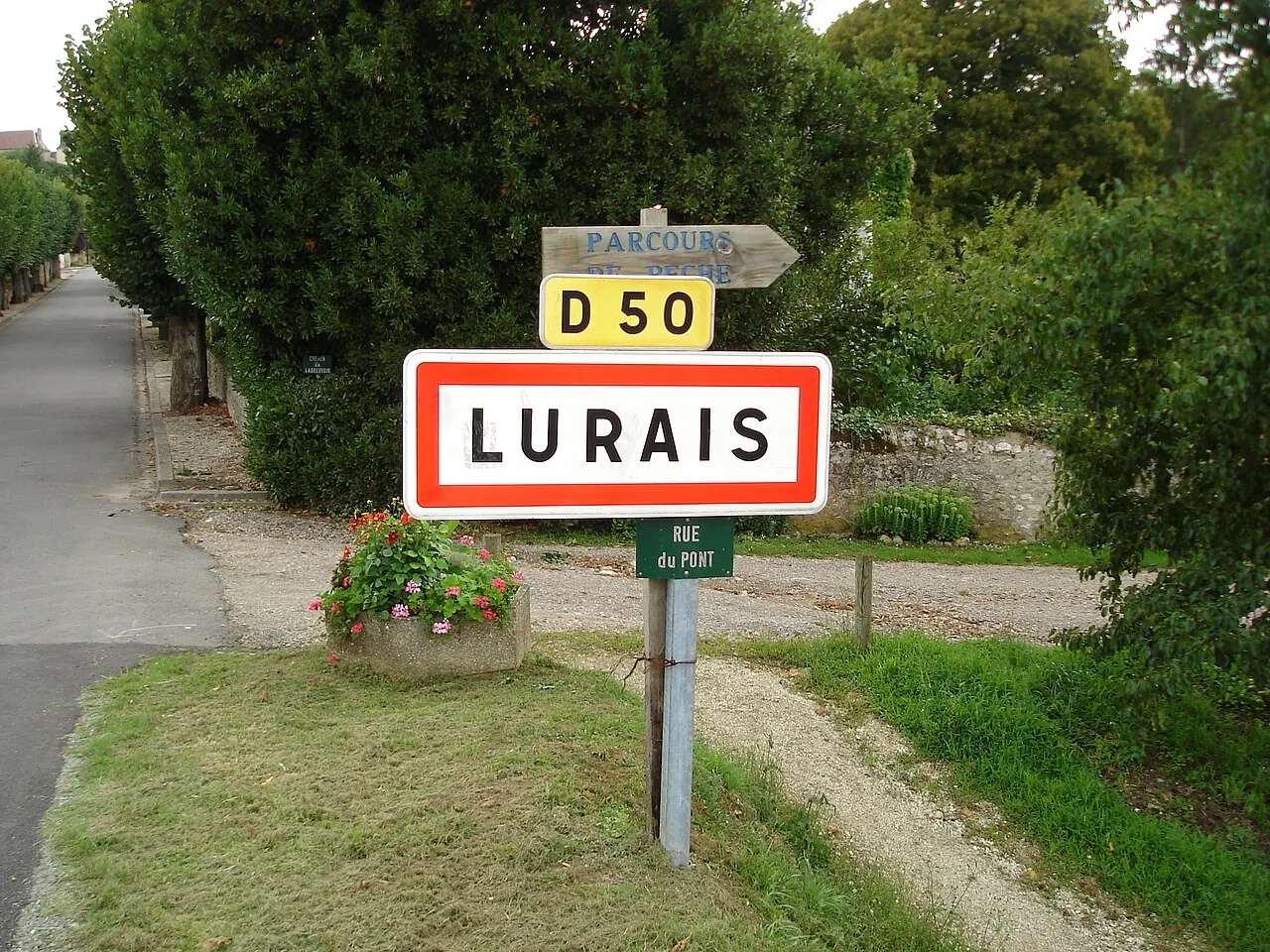
- panneau d’entrée d’agglomération a town’s name, black on white with a red border50
50 km/h from this sign, unless another says 30. Many towns are now 30 throughout.
- panneau de sortie the same name with a red bar80 or 90
End of the town limit: back to 80, or 90 where the département has chosen it.
- zone 30, zone de rencontre 30 zone; shared zone30 / 20
30 km/h; or 20 km/h with pedestrians having priority everywhere.
- pluie rainminus 10 or 20
Motorways drop from 130 to 110, dual carriageways from 110 to 100, without any sign.
- rappel reminderstill applies
Under a limit sign: the limit you were given earlier still applies.
Words under the signs
| French | English | So |
|---|---|---|
| sauf riverains | except residents | No entry unless you live or are staying in the street. |
| sauf desserte locale | except local access | Through traffic forbidden. |
| sauf livraisons | except deliveries | Not for you. |
| sauf bus, taxis, vélos | except buses, taxis, bikes | A bus lane: cameras watch it. |
| interdit sauf Crit’Air 0, 1, 2 | only those sticker classes | A low-emission zone. |
| par temps de pluie | in rain | The limit shown applies when it rains. |
| sur 2 km | for 2 km | The length the hazard lasts. |
| à 150 m | in 150 m | The distance to it. |
| toutes directions | all directions | Follow this out of a town centre when your destination is not signed. |
| autres directions | other directions | Everything not listed on the other arm. |
| déviation | diversion | Follow the yellow signs. |
| route barrée | road closed | Turn round. |
| chaussée déformée | uneven road | Slow down. |
| gravillons | loose chippings | Slow down and keep your distance. |
| verglas fréquent | ice often forms here | In winter. |
| voie sans issue | no through road | A dead end. |
The colour of direction signs
Following signs out of a town
A6 LYON
A motorway, usually with tolls.une autorouteDIJON
A main route between large towns, free.un itinéraire principalBeaune
A local destination.une direction localeDéviation
Temporary: roadworks or a diversion. It overrides the others.un panneau temporaire
A sign with Bis in a green and yellow panel marks a quieter alternative to a holiday motorway. Brown signs point to tourist sights. On a green sign, péage in a small box means the route shown uses a toll motorway.
Roundabouts
- Give way on entering
At almost every roundabout, a cédez le passage sign gives priority to traffic already on it. That is the opposite of priorité à droite.
- The exceptions
At the Arc de Triomphe in Paris and a few old junctions, cars entering have priority, because there is no give-way sign. If you see none, give way to the right.
- Which lane
Right lane to turn right or go straight; left lane to go left or all the way round, moving out before your exit.
- Indicators
Left while you stay on, right as you pass the exit before yours.
Parking
Lines along the kerb
- marquage blancA marked bay: free or paid, read the sign and the meter.park
- zone bleueFree for a limited time with a parking disc on the dashboard.park
- ligne jaune discontinueNo parking; you may stop to drop someone off.stop only
- ligne jaune continueNo stopping and no parking.no
| French | English |
|---|---|
| payant | pay at the machine or by app |
| horodateur | the pay machine: it asks for your number plate |
| stationnement alterné | park on one side in the first half of the month, the other in the second |
| côté pair, côté impair | the even-numbered, odd-numbered side of the street |
| jour de marché | market day: no parking, cars are towed |
| livraisons | loading bay |
| mise en fourrière | vehicles will be towed away |
| disque obligatoire | parking disc required |
Four more that surprise
Not signs, but rules
- Traffic lightspas d’orange avant le vert
French lights go straight from red to green. A flashing amber arrow lets you turn if the way is clear.
lights - Flashing headlightsun appel de phares
Means “I am coming through”, not “after you”.
opposite meaning - Pedestriansun passage piéton
You must stop for anyone stepping onto a crossing or clearly about to. Six points if you do not.
stop - Motorway overtakingdépasser par la gauche
Only on the left; return to the right lane afterwards. Staying in the middle lane is fined.
keep right
| French | English |
|---|---|
| un panneau | a road sign |
| un carrefour, un rond-point | a junction, a roundabout |
| céder le passage | to give way |
| un sens unique, un sens interdit | a one-way street, no entry |
| un ralentisseur, un dos-d’âne | a speed bump |
| un radar | a speed camera |
| un passage à niveau | a level crossing |
| serrer à droite | keep to the right |
Checked 20 November 2026. The national limits (50 in a built-up area, 80 on ordinary roads, 110 on dual carriageways, 130 on motorways, less in rain and for new drivers) were read on Service-Public. Which départements have gone back to 90, and which towns are 30 throughout, was not checked: the sign at the roadside decides.