Tipping in France: when, how much and what to say
Service is included in French prices by law, so a tip is a thank-you, not a wage. Pick the situation and see what people actually leave, and the phrase that goes with it.
French menu prices already include a 15% service charge, shown as service compris. Nobody expects a percentage on top. People leave small change when they are pleased, and nothing when they are not.
Yellow the idea to rememberBlue French to learn
Where are you?
I am…
Having a coffee
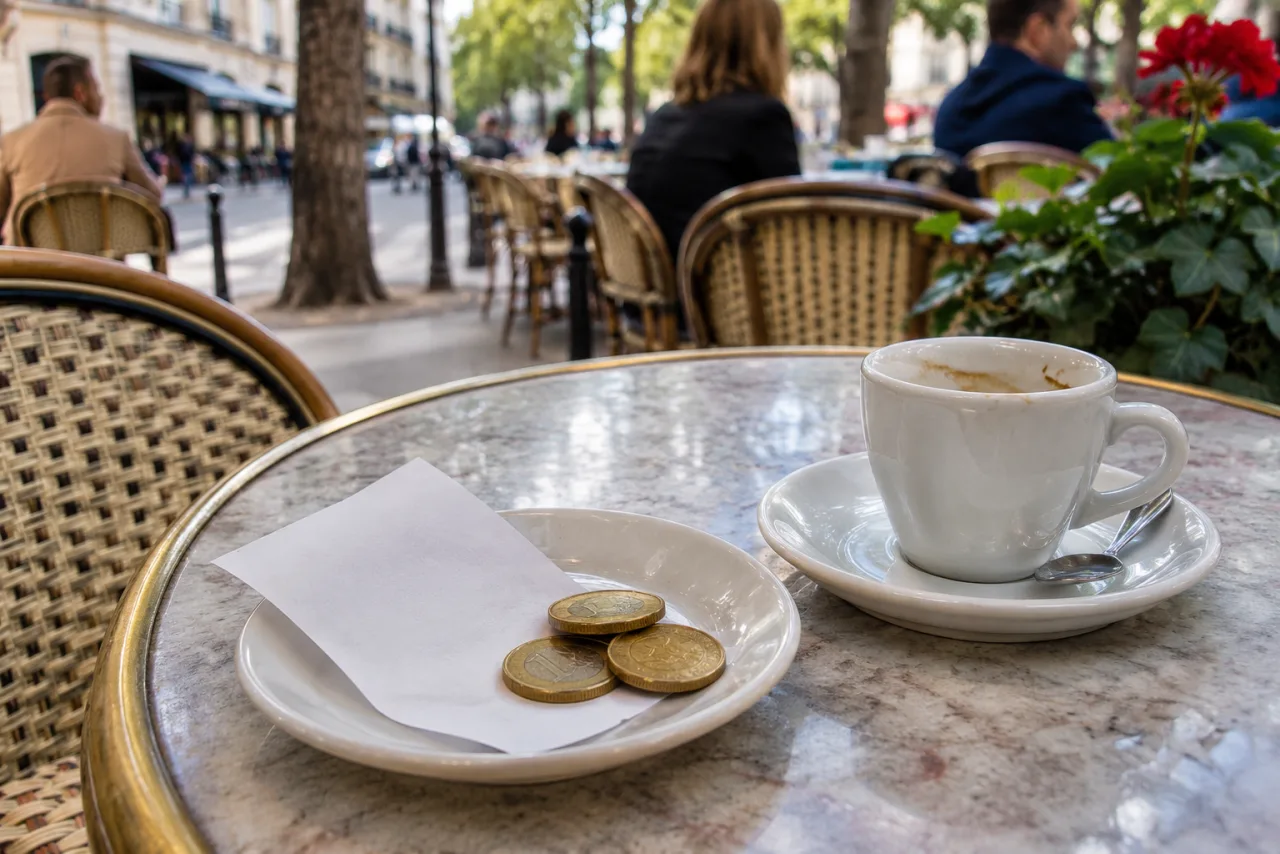
Leave the small coins, or nothing
au café
At the counter, nothing. At a table, people often leave the ten or twenty centimes of change in the saucer.
- How
- Leave the coins in the small dish the change comes in.
- At the bar
- Standing at the counter, nobody tips.
💬« Gardez la monnaie. » Keep the change.
In a restaurant
A euro or two a head, if it was good
au restaurant
For an ordinary meal, round up or leave one or two euros each. For a long, careful dinner, five to ten euros on the table. Not leaving anything is not rude.
- How
- Cash on the table as you leave. It goes to the staff directly.
- The bill
- Look for service compris: it is on every bill, by law.
- Fine dining
- Five to ten percent is generous and appreciated.
- Paying by card? Leave coins on the table: French card machines rarely ask for a tip, though some now do.
💬« C’était très bon, merci. » That was very good, thank you.
In a taxi
Round up
en taxi
Round the fare to the next euro or two. A little more if the driver carried bags.
- How
- Say the rounded amount as you pay: Dix-huit, s’il vous plaît, on a fare of 17.20.
- Bags
- A euro per large bag is courteous.
💬« Vous pouvez arrondir à dix-huit. » Round it up to eighteen.
At the hairdresser
A couple of euros
chez le coiffeur
Two to five euros, handed to the person who cut your hair, is common but optional.
- How
- Hand it to the stylist, or put it in the box by the till marked pourboires.
- Barbers
- Round up to the next five.
💬« C’est pour vous. » This is for you.
In a hotel
Only for real help
à l’hôtel
A euro or two for a porter who carries bags. Nothing at reception.
- Housekeeping
- A euro or two a night on the pillow, in better hotels only.
- Concierge
- Only for a real favour, such as finding a table.
💬« Merci pour votre aide. » Thank you for your help.
Getting a delivery
A euro or two, in the app or in hand
une livraison
Riders are paid per delivery; this is the one place a tip makes a real difference.
- How
- The app asks after delivery, or hand over a coin at the door.
- Rain
- In bad weather, a little more is the decent thing.
💬« Tenez, c’est pour vous. Bon courage ! » Here, this is for you. Good luck out there!
On a guided tour
Yes, for ‘free’ tours
une visite guidée
Free walking tours are paid only by tips: five to ten euros each is normal. For a paid tour, nothing is needed.
- How
- Cash to the guide at the end.
- Paid tours
- Museum guides and coach-tour guides do not expect one.
💬« Merci, c’était passionnant. » Thank you, that was fascinating.
What to say
| French | English |
|---|---|
| Gardez la monnaie. | Keep the change. |
| C’est pour vous. | This is for you. |
| Le service est compris ? | Is service included? |
| Un pourboire | A tip (literally ‘for drinking’) |
| C’était très bon, merci. | That was very good, thank you. |
Why service is already in the price
Since 1987, French law has required cafés and restaurants to display prices with service included. The 15% is part of the bill and of the staff’s wages: waiters are salaried employees, paid at least the minimum wage, with paid holidays and health cover. A tip is extra, kept by the person who served you or shared among the team.
The tips nobody tells you about
Restaurants are the easy part. The French tip on a few other occasions that surprise newcomers, and one of them comes to your door.
- Les calendriers
In November and December the postman, the firefighters and the refuse collectors call with next year’s calendar. You are not buying it: you give what you like, usually five to ten euros, and they hand it over.
- Les étrennes
A New Year gift in cash to the caretaker of your building, le gardien or la gardienne, in an envelope with a card.
- Ushers
In some private Paris theatres the person who shows you to your seat is paid mainly in tips. A euro or two each. In state theatres and cinemas, nothing.
- Free walking tours
The guide is paid only by what the group gives at the end. Ten euros a person is usual.
- Attended toilets
A saucer by the door in stations and department stores: fifty centimes.
Tipping by card
More and more payment terminals now show a screen offering to add a tip before you tap. You may press Non without embarrassment. If you want to leave something and have no coins, say Vous pouvez ajouter deux euros before the amount is typed in.
Paying, line by line
Asking for the bill and leaving a tip
- You
L’addition, s’il vous plaît.
The bill never comes until you ask. - The waiter
Par carte ou en espèces ?
Card or cash? - You
Par carte.
The terminal is brought to the table. - The waiter
Voilà. Bonne journée !
Service is already in the price. - You
Merci, gardez la monnaie.
Only if you are leaving coins: “keep the change”.
A tip is a thank-you, not a duty: a coin or two for a coffee, a few euros after a good meal.
Three things to know
- Read the bill
Service compris or prix nets at the bottom means nothing has to be added.
- Do not tip 20%
A large tip is accepted, with surprise. It is not the custom.
- A word counts
Merci, bonne journée on the way out is the part of the ritual that is not optional.
What the bill looks like
- 2 formules midi
- — , —
- 1 carafe d’eau
- 0,00
- 2 cafés
- — , —
Total TTC— , — €
Prix nets · service comprisService compris is printed on every bill: the 15% is already in the prices. The coins are a thank-you, not a duty.
What to leave
Service is in the price; this is extra
- A coffee at the counter
nothing
- Lunch in a café
1the small change
- A good dinner for two« Gardez la monnaie. »
221about 5 €
- A taxi
1round up
Custom, not a rule: nobody will follow you out.